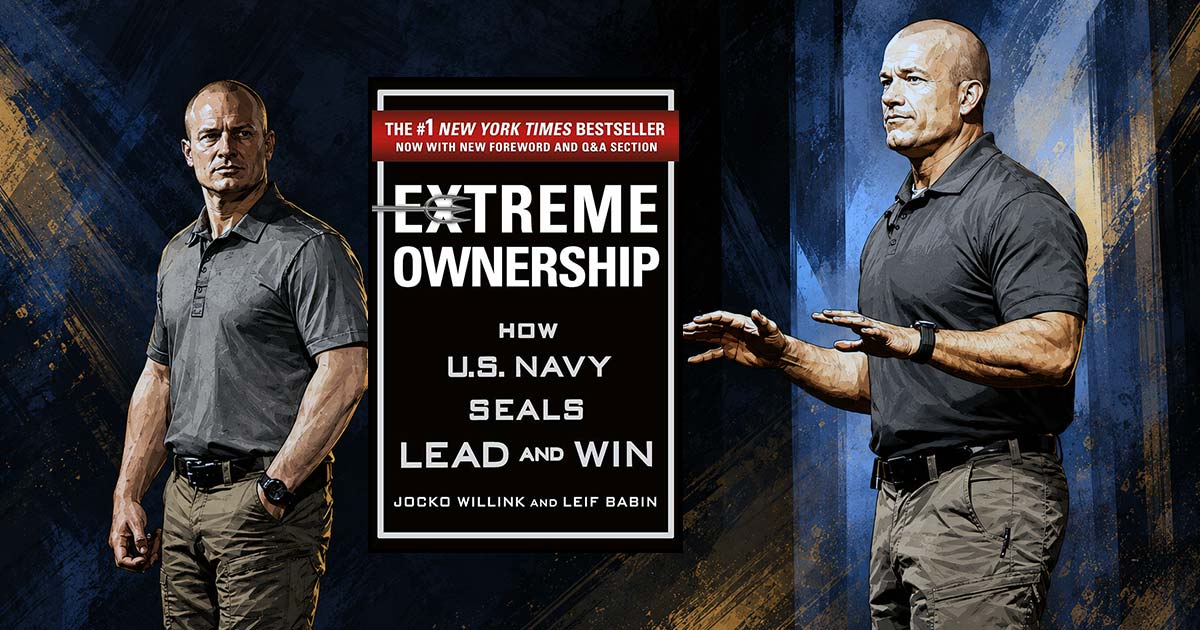
The main argument in Extreme Ownership is hard to disagree with. If you’re responsible for a team and your first explanation for every failure is that everybody beneath you screwed up, you probably haven’t looked hard enough at your own part in it. That doesn’t mean every failure belongs to the leader.
That’s where I think the book becomes more useful when I apply it instead of treating the title like a literal rule. If an employee repeatedly misunderstands an assignment, I should ask what I did before I decide the entire problem belongs to them. Was I clear? Did I explain what the finished product should look like? Did they have the training and resources to do it? Did I follow up? Did I know there was a problem and let it continue?
Sometimes the answers to all of those questions are yes and the employee still failed. That happens. But I want to know I’ve looked at my part before I start assigning everybody else’s.
That same idea shows up in the way I think about direction. When I tell somebody what to do, I still carry some responsibility for what happens after I give it.
Subscribe to Field Notes
The stories and ideas I don’t want you to miss.
I also agree with the book’s emphasis on people understanding what they’re trying to accomplish, not just what they’ve been told to do. If officers understand the goal, they can make better decisions when circumstances change. If all they know is the instruction, they’re much more dependent on somebody being there to tell them what comes next.
And circumstances change.
A plan can look clean in a meeting and fall apart the first time real people have to carry it out. The more moving parts you add, the more chances there are for somebody to misunderstand something, miss a handoff, arrive late, or discover that one of the assumptions behind the plan was wrong. My job isn’t to pretend every problem is simple. It’s to make sure the part that can be made clear actually is.
Where I push back on Extreme Ownership is the line between responsibility and cause. A leader can be responsible for dealing with an outcome without personally causing everything that produced it. An officer can receive clear instructions, understand the policy, have the training, know exactly what’s expected, and still choose to do something wrong. At that point, moving all of the responsibility back up the chain doesn’t create accountability. It can take accountability away from the person who made the decision.
Public service makes that distinction even clearer. A police chief may be responsible for running a department, but he doesn’t control the city budget, write state law, control the courts or county jail, decide whether a neighboring agency has enough people, or determine whether qualified applicants walk through the door.
None of that gives me permission to shrug and say it isn’t my problem. I still have to work within the conditions I have, explain the limitation, find another way when one exists, and make the best decision I can.
But responsibility and control aren’t the same thing. There is a difference between saying, “This happened under my leadership, so I need to deal with it,” and saying, “Everything that happened was my fault.” The first one I can live with. The second one can become its own kind of avoidance, because if I take responsibility for every decision made below me, eventually nobody below me has to. That’s not the organization I want.
I should set the standard, explain it, provide what people need to meet it, correct problems when they appear, and own the decisions that are mine. Then everybody else still has to own theirs.