Most people don’t deal with traffic stops very often.
Police officers do, and that difference alone can create a lot of uncertainty. You may wonder why the officer is still sitting behind you instead of walking up, why you’re being asked a particular question, or why something that seemed simple is taking several minutes. Sometimes there’s a reason you can’t see from the driver’s seat. Sometimes it’s simply part of the process.
This is written primarily with Alabama traffic stops in mind. Every stop is different, and agencies may handle some details differently. The goal is to explain what commonly happens, what the officer may be doing that you can’t see, and how to deal with a disagreement without turning the roadside into the place where it has to be settled.
When you see the lights
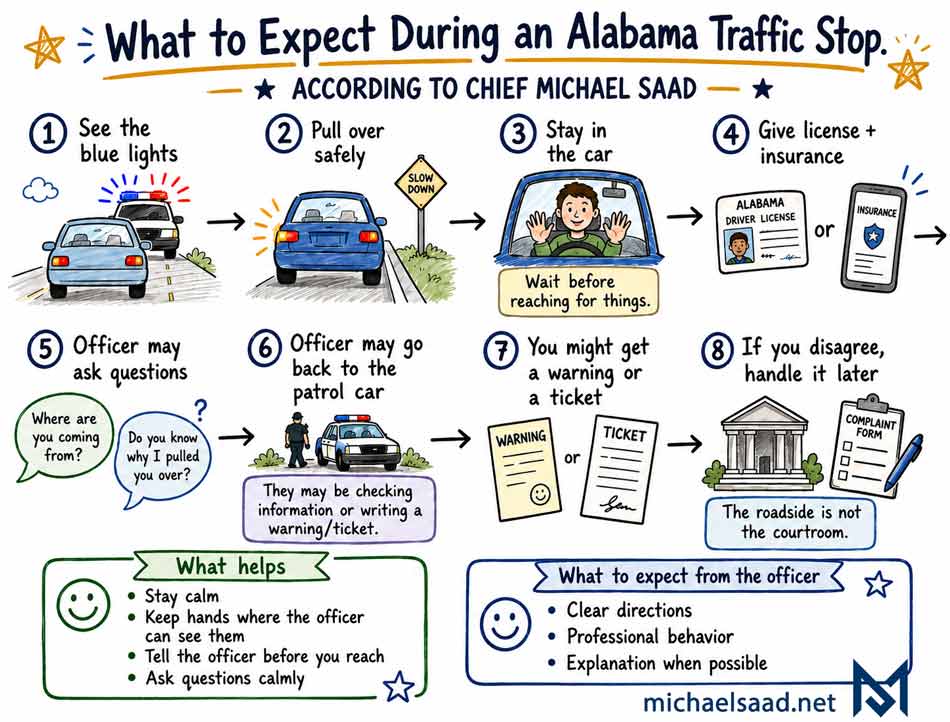
Slow down and start looking for a reasonably safe place to stop. Use your turn signal so the officer knows you’ve seen the emergency lights and intend to pull over. If there isn’t a safe place immediately available, slow down, signal, and stop as soon as you reasonably can. A narrow road, blind curve, bridge, or place with no shoulder may put both you and the officer in a worse position.
Subscribe to Field Notes
The stories and ideas I don’t want you to miss.
Once you’re stopped:
- Put the vehicle in park.
- Turn down the radio.
- Stay in the vehicle unless the officer tells you otherwise.
- At night, turn on the interior light if you can do so safely.
- Keep your hands where the officer can see them.
- Ask passengers to remain calm and avoid unnecessary movement.
There’s no need to start digging through the glove box or center console before the officer reaches you. You know what you’re reaching for. The officer walking up behind you doesn’t. I find it easier when the driver waits until I ask for something, tells me where it is, and then reaches for it.
Why the officer may sit behind you for a minute
An officer may remain in the patrol vehicle for a minute or two before walking up. That doesn’t automatically mean there’s a problem.
The officer may be notifying dispatch of the stop and location, checking the vehicle’s tag, looking at the vehicle and its occupants, reviewing what led to the stop, or positioning the patrol car to make the stop safer. Depending on the circumstances, the officer may also be waiting for traffic to clear enough to approach or waiting for another unit.
Roadside safety is a bigger part of traffic stops than most people realize. A shoulder that looks wide from inside your car can feel very different when you’re standing beside moving traffic.
The first conversation
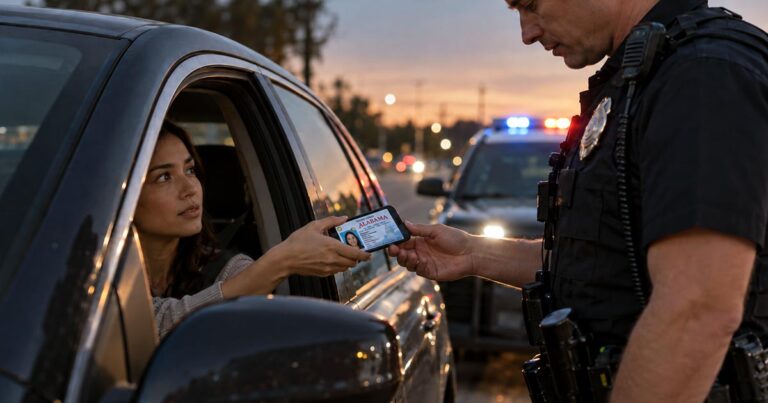
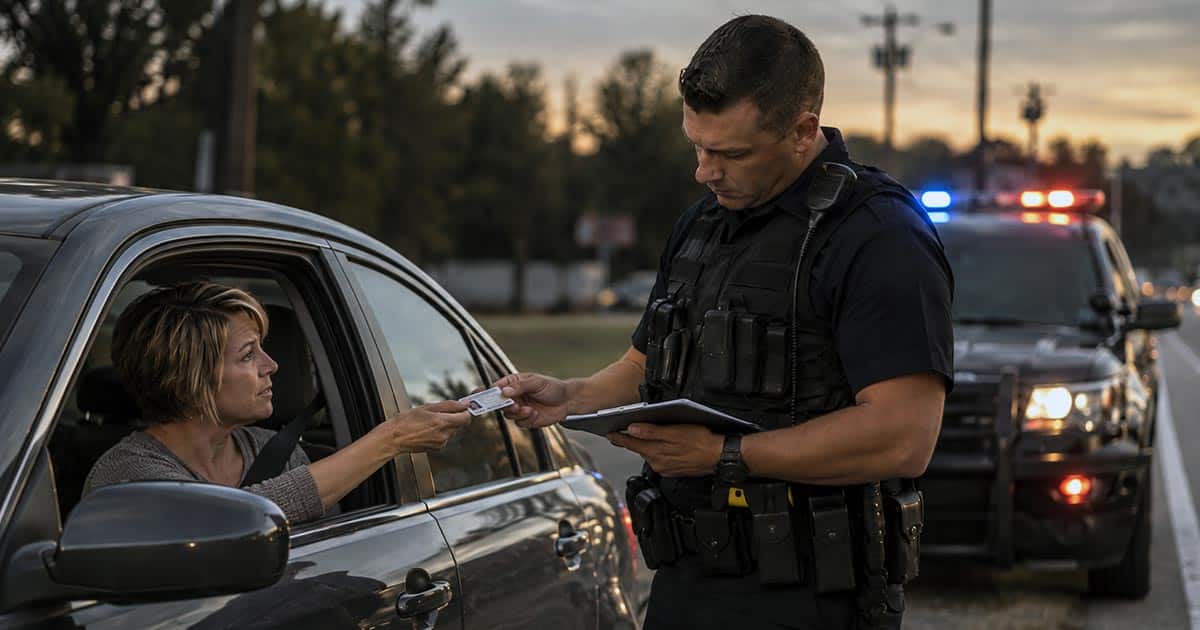
The officer will usually ask for your driver’s license and proof of insurance and explain why you were stopped. The order can vary. Personally, I usually get the driver’s license first and then explain the reason for the stop.
Once I say, “I stopped you for speeding,” some people immediately want to argue about whether they were speeding. I’d rather complete the basic identification part first, then explain what I saw and deal with any questions from there.
Alabama law requires a driver to have a driver license in their immediate possession while driving and to display it when lawfully requested by a police officer. That word, “display,” has caused some confusion because people sometimes take it to mean they can hold the license up to a window without allowing the officer to inspect it.
Alabama courts have addressed that issue. In Sly v. State, the Alabama Court of Criminal Appeals described an officer conducting a lawful traffic stopA temporary detention of a driver and vehicle by law enforcement to investigate a suspected traffic or criminal violation or another lawful concern. as having the statutory right to request and inspect the driver’s license.
In practical terms, if an officer asks for your driver’s license during a lawful traffic stop, hand it to the officer so it can be inspected.
Alabama is moving toward an actual digital driver’s license through ALEA. That is different from showing an officer a photograph or screenshot of your physical license on your phone. The state-approved digital credential is still being implemented, so I wouldn’t treat a picture in your photo app as the same thing.
Alabama does allow proof of insurance to be shown electronically, including a photo on a phone. The law specifically says that showing electronic proof of insurance doesn’t give law enforcement consent to access other content on the device. Section 32-7A-6 covers the electronic-display rule.
An officer can often verify a driver’s license, vehicle registration, and even insurance information through the systems available in the patrol car. I still wouldn’t use that as a reason not to carry the documents you’re supposed to have.
Computers go down. Connections fail. Systems lag. Information may not be available when the officer needs it, and the fact that something can usually be verified electronically doesn’t mean it always can be.
If you’re required to carry or produce a document, the safest assumption is that you should still have it with you rather than depending on the officer’s computer to fill the gap.
It also helps to tell the officer before reaching for something. “My license is in my wallet,” or, “My insurance card is in the glove box. Is it okay if I reach for it?” removes some uncertainty for both.
The officer may also ask questions about what was observed or the circumstances surrounding the stop. You can ask why you were stopped too. If something I say doesn’t make sense, I’d rather the driver ask what I mean than sit there guessing.
Why the officer may return to the patrol vehicle
After getting your information, the officer will often return to the patrol vehicle. This is probably the part of a traffic stop that feels the longest when you’re sitting there waiting.
The officer may be verifying license and vehicle information, checking something that could affect the stop, talking with dispatch, preparing a warning or citationA written notice accusing a person of an offense and directing them to pay a fine, respond, or appear in court. A citation may be issued instead of a custodial arrest for some offenses., or completing documentation. A delay doesn’t necessarily mean the officer has discovered some serious problem.
Officers need to remember that the driver can’t see any of that. When circumstances allow it, something as simple as, “Give me a few minutes while I check everything,” can remove a lot of unnecessary uncertainty.
Why you may be asked to step out
Many years ago, I was speaking to a class at Dixie Academy in Louisville when a senior asked why I made her get out of the car during a traffic stop. Her mother believed I couldn’t require her to do that. It was a fair question. From their perspective, being ordered out of the car felt like something that should require an additional reason.
Most people have no reason to know what the Supreme Court has said about it, but they addressed drivers in Pennsylvania v. Mimms, holding that during a lawful traffic stop an officer may order the driver out of the vehicle.
The Court later extended that rule to passengers in Maryland v. Wilson.
There are plenty of reasons an officer may want someone outside the vehicle. Traffic, the location of the stop, difficulty communicating, something developing during the investigation, or a safety concern may all play a part. The officer may not explain the reason before giving the direction.
If an officer tells you to get out, follow the direction calmly and ask where the officer wants you to stand. Following the direction doesn’t mean you’re agreeing that everything about the stop was handled correctly. It means you’re dealing with the roadside situation first. If you believe the officer acted improperly, there are ways to address that afterward without trying to resolve it beside moving traffic.
A traffic stop can change
A stop may begin with something as simple as speeding, a tag violation, or an equipment problem and remain exactly that. Sometimes something else develops.
An officer may observe something, receive information, learn about another issue involving the driver or vehicle, or encounter circumstances that need to be addressed before the original stop can be finished. That doesn’t mean every delay or additional question means something serious is happening. It does mean a stop that begins over one issue doesn’t necessarily end there.
What the officer may decide
Not every traffic stop ends with a ticket. Depending on the law, the circumstances, department policy, and what happens during the stop, an officer may give a warning, issue a citation, take no further enforcement action, continue investigating something that developed during the stop, or make an arrestTaking a person into legal custody based on probable cause, a warrant, or another lawful authority. when the circumstances support it.
Officers sometimes have discretion in how they handle a violation. That doesn’t mean they can do whatever they want. It means the law or department policy may allow more than one reasonable response. When I’m making that decision, I try to separate what I know from what I’m assuming. The driver may know something I don’t know, and I may know something the driver doesn’t. The decision should come from the facts I can support, not from irritation or a need to win the encounter.
If you get a ticket
Read it and the instructions that come with it before putting it somewhere and forgetting about it. It should identify the violation and tell you what happens next.
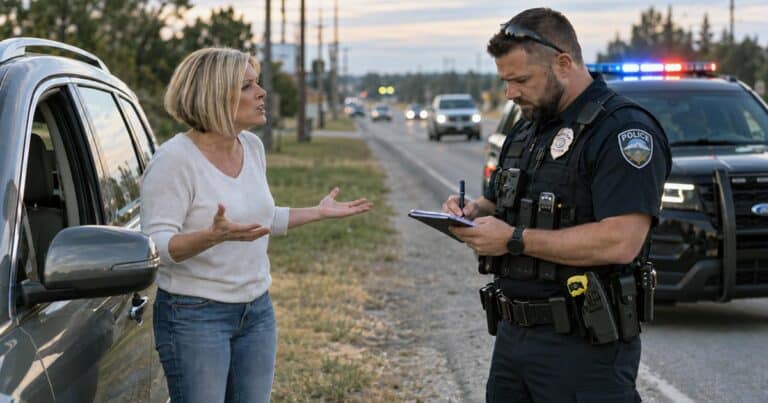
If you disagree with the ticket, the roadside usually isn’t where that disagreement gets decided. Follow the instructions on the citation and use the court process available to you. Don’t ignore a court date, deadline, or other requirement because you believe the ticket was wrong.
If something is unclear before you leave, ask. You may need to know whether you have to appear in court, where the court is, whether the date is shown on the citation, or whether there are instructions you need to read.
The officer can explain the basic process. The officer isn’t the judge, and the traffic stop isn’t the final decision about whether the citation is correct.
If you believe the officer acted improperly
Staying calm during a traffic stop doesn’t prevent you from questioning what happened afterward. If you believe the officer acted improperly, write down what you remember as soon as you reasonably can:
- The date, time, and location
- The agency involved
- The officer’s name or identifying information, if you have it
- The patrol vehicle number, if you noticed it
- The citation or case number
- What was said and done, in order
- The names of witnesses
- Any video, photographs, or other records that may matter
Then contact the department and ask how its complaint or review process works. Be specific about what you believe happened and what you want reviewed.
A complaint about an officer’s conduct and a challenge to a traffic citation may be two separate things. Filing one doesn’t necessarily take care of the other. A good complaint process should give people a real way to raise concerns while giving the department enough information to identify the stop, preserve relevant records, and determine what happened.
What you should expect from the officer
Traffic-stop advice sometimes turns into a list of everything the driver is supposed to do. That leaves out half of the encounter. You should expect an officer to act professionally. That includes treating you with respect, giving understandable directions, avoiding unnecessary escalation, accurately documenting the stop, and explaining the outcome and next steps when circumstances allow.
Professional doesn’t necessarily mean friendly, and it doesn’t mean the officer has to agree with you or give you the outcome you want. An officer can be direct, issue a citation, give a lawful order you don’t like, or continue investigating something that develops during the stop and still act professionally.
The officer should also be able to control their own behavior. Your irritation doesn’t give the officer permission to become unnecessarily confrontational, and a disagreement doesn’t need to become a personal argument.
What the officer needs from you
The same works in the other direction. You may be frustrated. You may think the officer is wrong. You may already know you’re going to contest the ticket. You can still deal with the roadside part of the encounter without making the disagreement harder than it needs to be.
You can help by:
- Pulling over in a reasonably safe place
- Staying in the vehicle unless directed otherwise
- Keeping your hands visible
- Telling the officer before reaching somewhere they can’t see
- Providing the documents required for the stop
- Listening to directions
- Asking questions when something is unclear
- Following lawful directions
- Using the court or department review process for disagreements that remain afterward
None of that requires you to pretend you agree with the officer. Asking a reasonable question or disagreeing with a ticket doesn’t automatically make somebody uncooperative either. The point is to keep disagreement from becoming unnecessary conflict.
Before you drive away
Before leaving, make sure the officer has returned your license and anything else you provided. Take your copy of any warning or citation and put it somewhere you’ll remember.
Wait until the officer tells you the stop is finished, then look carefully before pulling back into traffic. If you’re stopped somewhere that makes it difficult to get back onto the road, ask whether the officer can help you merge safely.
A traffic stop brings together two people who may have different information, concerns, and expectations. You don’t have to agree with everything that happens to understand what is happening, preserve your rights, and deal with any remaining disagreement in the place where it can actually be resolved.
Legal Notice: This article provides general public information about traffic stops, with an emphasis on Alabama law. It isn’t legal advice. Laws and court decisions can change, and individual circumstances may affect how a particular stop is handled.