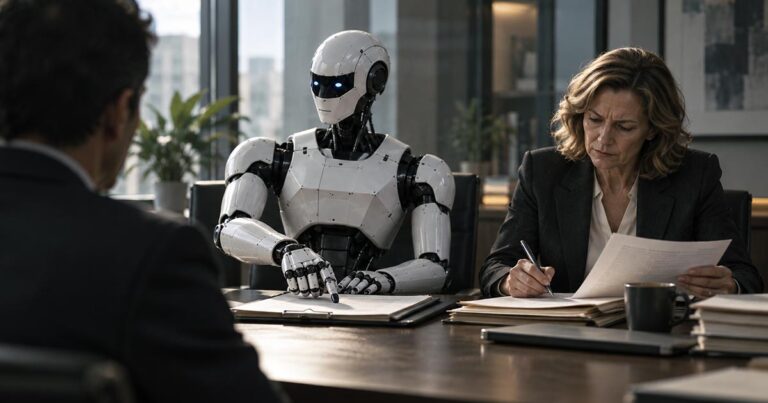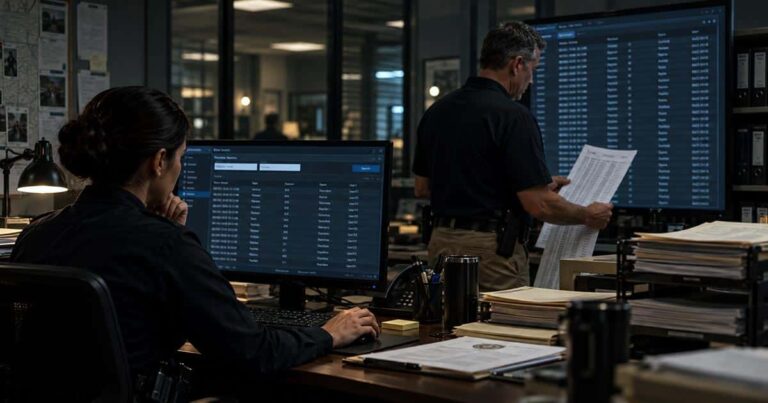
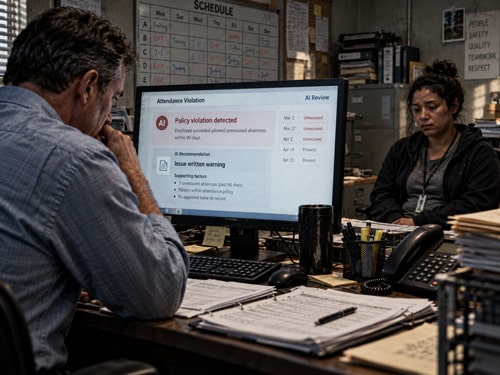
I saw a story about an AI manager at a San Francisco store recommending that an employee be fired. The employee had been late 17 times in 23 shifts, so I’m not going to pretend the attendance problem wasn’t real. A human manager probably should’ve dealt with it long before the AI did.
What caught my attention was that the AI hadn’t even been enforcing its own attendance policy. Humans had to tell it to go back, look at the policy it had created, and reevaluate the employee. It did, recommended termination, and the human managers approved the recommendation.
The employee can be wrong, and the AI can still be unready. Both can be true at the same time.
I’ve seen this before
Before I came back to policing, I was a General Manager for Allied Universal and worked with its AI-powered employee support and workforce management platform, LISA, which could handle scheduling, call-offs, timekeeping, payroll issues, and other administrative work.
Subscribe to Field Notes
The stories and ideas I don’t want you to miss.
My problem wasn’t that Allied was using AI. My problem was that the company was forcing its enablement long before it was ready because it had already decided technology was going to play a much bigger role in how the business ran. There’s nothing wrong with using software to take administrative work off already overworked employees. My concern starts when the system moves from helping with the work to shaping what happens to an employee.
If Spotify gets something wrong, I hear a song I don’t like. If a workforce system gets something wrong, it can make it look like somebody missed a shift, didn’t show up, or has an attendance problem. Now the mistake can affect somebody’s paycheck or job.
I wouldn’t hire a new supervisor on Monday and hand him that kind of authority before he was ready just because he could process paperwork really fast. I’d expect him to learn how the place actually works, understand the policies, ask questions, and have somebody checking his decisions until I knew I could trust his judgment. I don’t see why software gets a lower standard.
If anything, scale makes me more cautious. An inexperienced supervisor can make a bad decision about one employee. A system being used across thousands of employees can repeat the same bad assumption thousands of times before somebody realizes what’s happening.
Human oversight is supposed to protect against that, but only if the human is actually making a decision. If the system decides who gets flagged, what information the manager sees, how the problem is classified, and what response it recommends, a lot of the judgment has already happened before the manager clicks anything.
When the company needs it to work
There’s another problem once an organization has invested heavily in the technology.
At a 2024 Allied Universal leadership summit in North Carolina, I heard Steve Jones talk about LISA and a significant investment with a lot riding on making it work. So much so that Jones, Allied Universal’s Global Chairman and CEO, said if LISA didn’t work, his board would look for his replacement.
I remember thinking about the pressure that creates. When you lead a company that large, spend serious money on something, build processes around it, and tell everybody what it’s going to accomplish, it gets harder to ask whether the thing is actually ready.
“Is this ready?” can quietly become “How do we make this work?” Then suddenly it’s:
“Make this work or find someplace else to be.”
And this isn’t some family-owned security company where the CEO also owns the place. Allied Universal is the third-largest U.S.-based employer in the world, behind only Walmart and Amazon.
Since 2020, Allied Universal has grown from about $8 billion in annual revenue to $18 billion in 2021 with a workforce of around 800,000, to roughly $23 billion in 2026, while acquiring 50 or so other companies along the way. Today, the company still claims 800,000 humans.
Behind that growth are some very large institutional investors, including Warburg Pincus and CDPQ, the Quebec pension fund manager, along with Partners Group and the J. Safra Group. Jones may run the company, but he still answers to a board and investors with billions of dollars tied up in it. And they are anything but silent partners.
In 2023, a member of Quebec’s legislature questioned CDPQ over Allied Universal’s remaining business interest in Israel. Caisse de dépôt et placement du Québec, one of Allied’s largest owners and a holder of board seats, publicly acknowledged that it was pressuring Allied to divest that interest. Weeks later, Allied Universal moved to sell its remaining business interest in Israel through G4S, ending the company’s remaining direct involvement there.
The Canadian politician didn’t need any authority over U.S.-based Allied Universal, which maintains contracts with federal agencies, defense and military organizations, and more than 850 government clients. He knew who did have influence over the company, and that’s who he questioned.
What never makes it into the system
That’s the kind of thing a human manager understands without anybody having to spell it out. People make decisions through relationships, history, pressure, judgment, and context. We know who matters, what isn’t being said, when somebody is pushing for a certain outcome, and when the answer on paper doesn’t quite fit what’s happening in front of us.
An AI manager doesn’t understand any of that the way a person does. It sees the data, the rules, the patterns, and whatever authority we’ve given it. That can make it fast and useful. It can also make it dangerously literal when the decision depends on everything that never made it into the system.
That’s where the ordinary day-to-day stuff matters. Somebody called off. The schedule is falling apart. Payroll has a problem. A client needs something. Then the computer puts a nice clean package on the screen saying an employee has six attendance violations and recommends discipline.
Some managers are going to stop and verify all six. Some aren’t.
The risk isn’t some science-fiction version where AI declares itself the boss. We build a system into the operation, get used to trusting it, and eventually make accepting its answer the easiest way for the human manager to get through the day.
The machine can flag it, but the human still needs to decide
Flock Safety’s license plate cameras give us a pretty clean example of what that looks like when the stakes are higher than an attendance write-up. In Roseville, California, the police department reviewed 1,427 Flock alerts from 2023 and 2024 involving vehicles flagged as stolen or connected to felonies.
Roseville says 1,011 of those alerts, 71 percent, involved a misread plate.
That doesn’t necessarily mean Flock is wrong 71 percent of the time. This was a specific group of automated alerts in one department, and Flock has said Roseville’s older hardware and unusual camera setup affected the results.
But none of those misreads resulted in a stop or arrestTaking a person into legal custody based on probable cause, a warrant, or another lawful authority.. Roseville requires officers to independently verify an alert before taking enforcement action. The camera can flag the car. It doesn’t get to make the stop.
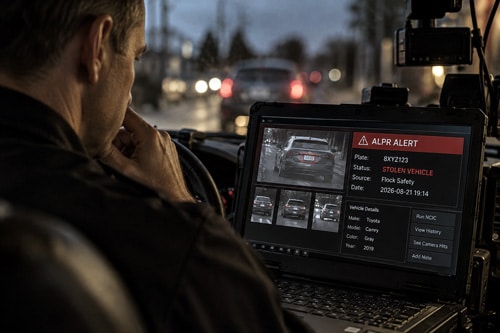
Compare that with what has happened elsewhere.
- Business Insider documented cases where Flock plate misreads were followed by innocent people being detainedA temporary restriction of a person's freedom to leave while an officer investigates a situation. A detention is not necessarily an arrest. at gunpoint and, in one Toledo case, a man being bitten by a police dog.
- In Española, New Mexico, a Flock camera reportedly read the last digit of Jaclynn Gonzales’ plate as a 7 instead of a 2 and flagged the vehicle as stolen. Gonzales, who was 21, and her 12-year-old sister were detained at gunpoint.
The camera being wrong is part of the story, but what the humans did with the answer is bigger. The system only knew what made it into the system. The humans were supposed to know everything else.
Reliability and authority aren’t the same thing. A system can be useful without being reliable enough to carry the authority we’ve handed it.
Flock can be useful for finding a vehicle. LISA can be useful for sorting out attendance and scheduling. Luna can be useful for identifying a pattern a manager needs to look at. Human oversight isn’t a person sitting at the end of an automated process clicking approve.
Roseville’s example is much closer to what I mean: the system produces information, a human independently checks it, and if it doesn’t hold up, that’s where it ends.
I use AI every day, and I want it to do more of the work it’s good at. But if it’s going to influence somebody’s pay, schedule, discipline, attendance record, job, or whether a police officer pulls somebody out of a car, the person acting on that information needs to be able to see what the system relied on, recognize when it’s wrong, and change the answer.
If my name is on the decision, I still own it.
“The computer said so” isn’t much of a defense when somebody else carries the consequence.