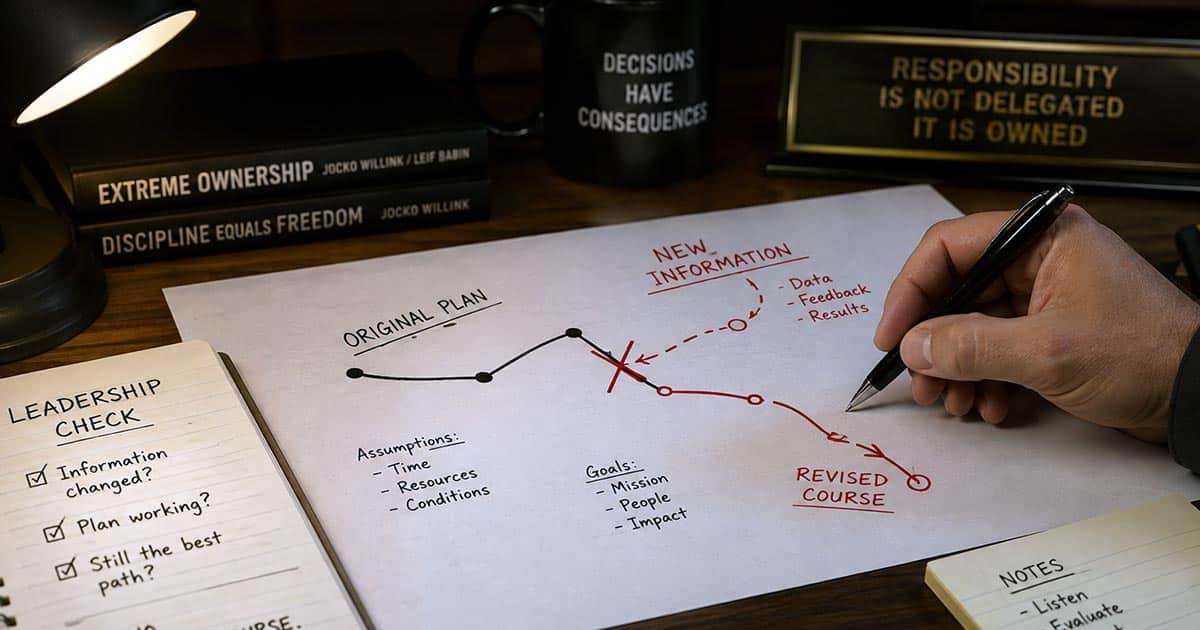
One of the easiest things to say about a leader is that they need to stand their ground, and sometimes they do. If you’ve made a sound decision for the right reasons, criticism by itself isn’t a reason to abandon it. Leadership would be pretty useless if every decision changed based on who was complaining the loudest that day.
But there’s a difference between standing behind a decision because you believe it’s right and continuing to defend one because you don’t want to admit you were wrong.
I think the first question should be pretty simple. Why did we make this decision in the first place? Maybe we were trying to solve a particular problem, maybe we had limited information to work with, or maybe we believed one approach would produce better results than another. Whatever the reason, that’s what we should be evaluating when somebody questions the decision. If the reasoning still holds up, I don’t see much reason to change course simply because somebody doesn’t like it.
That doesn’t mean criticism should be dismissed, either. I’ve had enough experience making decisions at a high level to know that the person responsible for one doesn’t necessarily have all the information. An employee may understand something about daily operations that isn’t obvious from a management position. Somebody affected by a new policy may recognize a problem that wasn’t considered when it was developed. And sometimes the people complaining are pointing out exactly what you need to hear, even if you don’t particularly like how they’re saying it.
Subscribe to Field Notes
The stories and ideas I don’t want you to miss.
The challenge is separating useful information from opposition for the sake of opposition. A hundred people disagreeing with a decision doesn’t automatically make it wrong, any more than a hundred people supporting it makes it right. Popularity isn’t a substitute for judgment.
But if those complaints reveal something I overlooked, I have a responsibility to consider it. Refusing to listen because somebody might interpret it as weakness doesn’t make me a stronger leader. It just means I’m making decisions with less information than I could have.
Sometimes changing course is fairly easy to explain. Circumstances change, new information becomes available, or something that made sense six months ago no longer makes sense today. There’s nothing particularly inconsistent about adjusting a decision when the conditions that justified it no longer exist.
The harder situation is when the circumstances haven’t changed at all. You simply realize that your original decision wasn’t a good one. Maybe you misunderstood the problem, made an assumption that turned out to be wrong, or gave a plan enough time to work and discovered that it wasn’t producing the results you expected. That’s when pride can start interfering with judgment. You’ve already committed to a position, perhaps even defended it publicly, and now changing your mind means acknowledging that you got something wrong.
I’d rather have to explain why I changed course than spend another six months defending something I no longer believe is working. I might have to explain what I missed, why I believed the original approach would work, and what I intend to do differently. None of those conversations are particularly comfortable, but they’re a lot easier to justify than continuing with a bad decision because I don’t want to have them.
Of course, there’s another danger in changing direction too quickly. Not every decision produces immediate results, and some of the right decisions are going to create resistance. If you change course every time implementation becomes difficult, you may never give a good plan an opportunity to work. Sometimes the complaints are coming from people who don’t want to change, don’t like being held accountable, or simply preferred the way things were. A leader has to recognize that possibility too.
That’s why I don’t believe consistency means refusing to change your mind. It means being consistent in how you evaluate the decision. If I expect other people to acknowledge mistakes, consider new information, and adjust when something isn’t working, I should be willing to do the same.
If I’m going to stand firm, I need to be able to explain why beyond telling somebody that I’ve already made up my mind. But once the reasoning behind it falls apart, continuing to defend it serves no useful purpose. If the reason no longer holds up, change course.