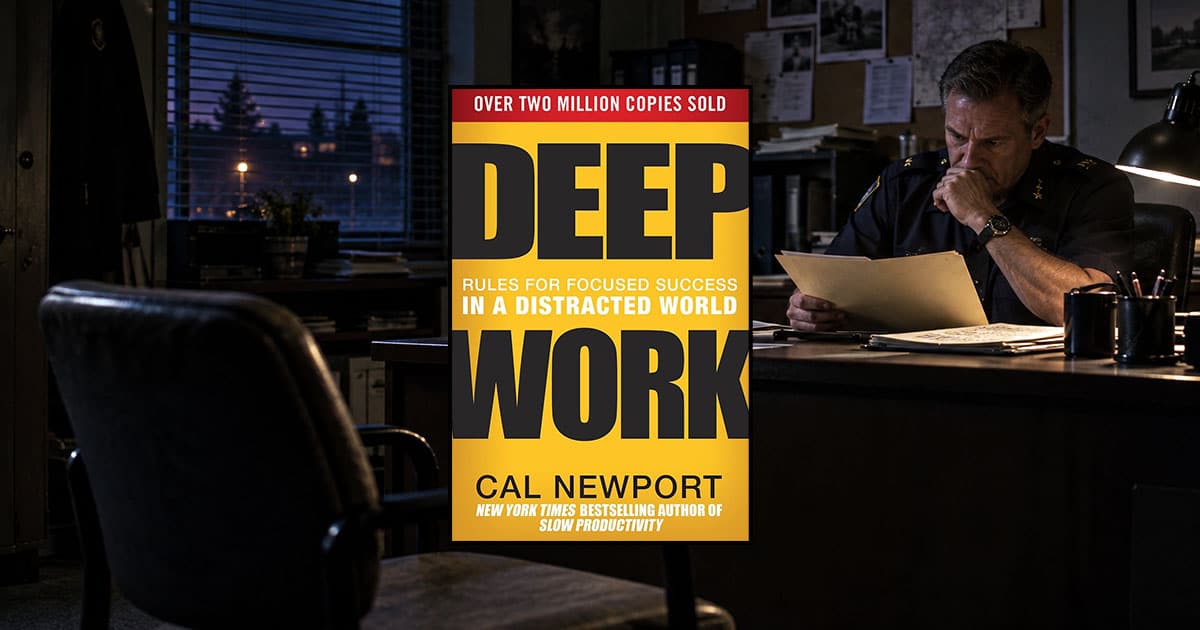
I like the idea behind Cal Newport’s Deep Work. There are certain things I do better when I can shut everything else out and concentrate on one problem long enough to actually think through it. Writing is one of them. So is working through policy, reviewing a complicated issue, or making plans that affect the department.
The problem is that policing doesn’t always give me that opportunity. I can block out two hours on my calendar, close the office door, put my phone down, and decide I’m going to work on one thing. Then another agency needs a decision, the mayor calls, somebody walks in with a complaint, or something happens in town that requires my attention. Whatever I was working on has to wait.
And sometimes that’s exactly how it should be.
A lot of productivity advice focuses on eliminating distractions. Turn off notifications, stop checking email, close the door, and don’t let people interrupt you. I understand the reasoning, and some of those things help. But I can’t tell an officer who needs a decision to come back in two hours because I’m concentrating on something else.
Subscribe to Field Notes
The stories and ideas I don’t want you to miss.
Being available is part of my job, just as it is for a fire chief, a doctor handling emergencies, or a business owner who has to deal with problems as they happen. I don’t consider those interruptions wasted time. If somebody needs my attention and I’m the person responsible for handling it, then handling it is part of what I’m there to do.
Not everything needs me right now
Where I run into trouble is allowing the legitimate interruptions to make every interruption seem legitimate. I’ve had plenty of days when I was busy from the moment I started until the moment I stopped, yet I couldn’t point to the thing I’d intended to finish.
That doesn’t mean I accomplished nothing. I may have handled dozens of problems, answered questions, helped employees, and made decisions that needed to be made. But the policy I needed to review is still sitting on my desk, and the issue I’ve been meaning to think through hasn’t received any more attention.
Some of the work that requires the most thought doesn’t announce itself as urgent. A hiring process that needs improvement isn’t going to call me on the radio. A policy that should be rewritten won’t interrupt a meeting. A recurring problem inside the department may continue for months because dealing with it requires more time and attention than answering the next phone call.
It’s easy to get accustomed to responding to whatever is immediately in front of you. The phone rings, so you answer it. An email arrives, so you read it. Somebody walks into the office with a question, so you stop what you’re doing to address it. After a while, you can start treating everything as though it needs an immediate response.
Sometimes it does. Other times, there’s nothing wrong with telling somebody I’ll get back to them this afternoon. That’s the distinction I’ve had to make. I need to remain available for the things that genuinely require my attention, but that doesn’t mean everybody else gets to decide what I’m working on every minute of the day.
I also have to recognize the opportunities when they come. There are times when I can accomplish more uninterrupted work early in the morning than I can during an entire normal workday. Fewer people are awake, the phone isn’t ringing as much, and there aren’t people walking through the door. I’ve found the same thing late at night or during an unusually quiet stretch of the day.
That isn’t a perfectly scheduled routine, but I don’t think it has to be. Newport’s larger argument about deep work still applies. The concentration has value even if I have to find smaller opportunities for it. If I have 45 uninterrupted minutes, I can use them to work through something that needs my attention, or I can spend them answering emails that could just as easily wait.
Sometimes I’m creating the interruptions
There’s another part of this that I can’t blame on the job. If I’m being interrupted constantly because nobody can make a decision without asking me first, I need to look at how I’m running the department.
In a small department, I expect to be involved in more of the daily operation. We don’t have layers of command staff or a separate person responsible for every function. But that doesn’t mean every routine question should make its way to my desk.
If supervisors don’t know what authority they have, they’re going to ask. If employees don’t understand the standard, they’re going to ask. And if I’ve established a practice of second-guessing every reasonable decision somebody makes without me, I shouldn’t be surprised when they stop making decisions on their own. I’ve created an organization where everybody waits on me, and then I’m complaining that everybody keeps interrupting me.
That’s a problem I have some control over. I can work on building an organization where employees understand their responsibilities, supervisors have the authority to do their jobs, and people know what decisions genuinely need to come to me.
That also means establishing clear expectations and allowing people to make reasonable decisions without worrying that I’ll criticize them afterward simply because I might have done something differently. I can’t expect independent judgment from employees while making them afraid to exercise it.
None of that eliminates emergencies or the situations where a chief needs to be involved. It does reduce the number of unnecessary interruptions that come from poor delegation or unclear direction.
I don’t think I can organize my job around four uninterrupted hours every day, and I wouldn’t want to be so unavailable that people couldn’t reach me when they needed to. But I also don’t want to spend every day responding to whatever happens next while the work that requires serious thought keeps getting postponed.
That’s what I take from Deep Work. I may not be able to control when the phone rings or what happens in town, but I have more control over some of the other interruptions than I sometimes give myself credit for.