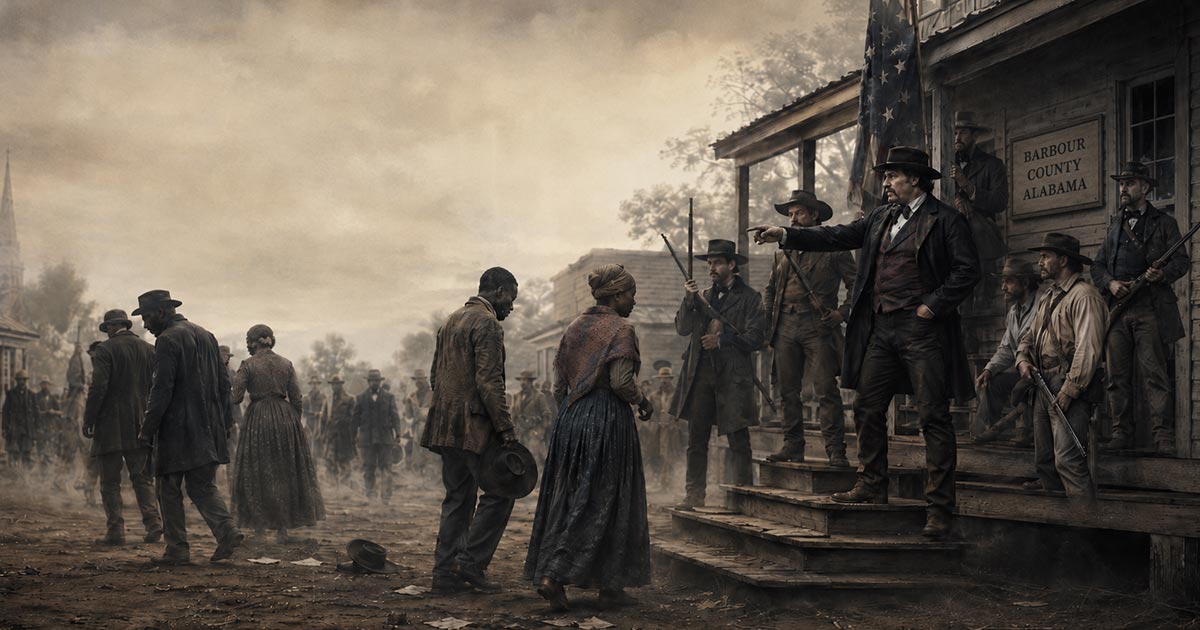
Ever wondered why Barbour County’s local offices are held almost exclusively by Democrats, even as voters here show diverse political preferences in state and national elections?
While our U.S. Senators are Republicans, and Barbour County voters regularly support candidates across party lines at the state and national level, our local politics tell a different story: from Circuit Clerk to Circuit Judge, Democrat candidates continue to dominate Barbour County’s local offices.
The political history behind it is easy to talk around and much harder to look at directly. This pattern isn’t about political philosophy or modern party platforms. Its roots trace back to a single day in 1874, a day of calculated violence that would reshape our county’s political landscape for generations to come.
The Republican stronghold
In the years following the Civil War, Barbour County maintained a strong Republican presence. This wasn’t just about party politics, it represented active participation in local government by all citizens. Black voters helped elect Republican candidates and white Reconstruction supporters to office, including Judge Elias Keils.
Subscribe to Field Notes
The stories and ideas I don’t want you to miss.
However, the events of November 3, 1874, would violently reshape our county’s political landscape through deliberate intimidation and murder.
The violence was meticulously orchestrated
On the eve of the election, hundreds of Black men marched to the polls in Eufaula, determined to exercise their constitutional right to vote as a right guaranteed by the 15th Amendment just four years earlier. Following the advice of Republican leaders, they came unarmed to avoid giving any excuse for violence.
Instead, they walked into a deadly trap… white employers had already fired Black workers who planned to vote Republican, and false rumors circulated about an “invasion” of Black voters planning violence. White residents, particularly those affiliated with the White League, a paramilitary group tied to the Democratic Party, had stockpiled weapons near polling stations. When Captain A.S. Daggett of the 2nd U.S. Infantry and his federal troops were barred from intervening by General Order No. 75, the stage was set for violence.
The spark at Spring Hill
The Election Massacre occurred simultaneously in Eufaula and Spring Hill. Tensions boiled over when Milas Lawrence, a Black Republican, was stabbed by William Dowdy during a confrontation with Charles E. Goodwin, a white Democrat.
What ensued was a calculated slaughter. The violence was ruthless and systematic: approximately 400 shots were fired within minutes by members of the White League, who targeted indiscriminately from streets and buildings. At least six Black citizens were killed, with up to 80 more wounded. Survivors recalled the chilling cries of “Hurrah for the white man’s party” echoing during the massacre.
The attackers were strategic in their targets
They assaulted the home of Judge Elias Keils, a Republican city court judge, killing his 16-year-old son Willie. This wasn’t random violence, it was a calculated message: voting Republican could be fatal. Approximately 500 Black voters fled without casting ballots, while others were driven from the polls at gunpoint. The aftermath revealed the massacre’s true purpose.
Justice denied
No white perpetrators were ever convictedA judgment that a person is guilty of an offense, entered after a guilty plea, a trial verdict, or another lawful court process.. Instead, a Black man named Hilliard Miles was imprisoned simply for identifying mob members. Hilliard Miles identified Braxton Bragg Comer, later became Governor of Alabama, as one of the participants.
But the violence was only the beginning. The White League refused to count any Republican votes cast, despite Republicans (who included both Black citizens and white supporters) outnumbering Democrat voters by more than two to one. In what amounted to a coup d’état, the League simply declared Democrat candidates victorious, forcibly removed Republican officials, and seized every county office in Barbour County.
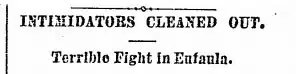
To ensure their version of events would prevail, they auctioned off Republican witnesses as “slaves” for up to $2 per month or otherwise silenced them to prevent federal court testimony. When the case finally reached a grand juryA group of citizens that reviews evidence presented by the prosecution and decides whether probable cause exists to issue an indictment., that jury blamed “militant” Black Republicans for creating a tense atmosphere in Eufaula.
The strategy worked exactly as intended
Republican voting was suppressed through fear and intimidation. Black voting in the county plummeted from 1,200 in 1874 to just 10 by 1876. The Democrats had nominated former Confederate Jeremiah Williams to oppose James Rapier, the Black Republican congressman representing the district. Their Pike County Platform explicitly called for social ostracism of anyone supporting Republicans. What began as violent voter suppression evolved into an unspoken rule that would control local politics for nearly 150 years.
Modern echo
Barbour County’s local offices remained Democratic not because of political ideology, but because of generational trauma and ingrained fear. Today, this pattern persists throughout our local government:
- Circuit Clerk
- Circuit Judge
- District Judge
- District Attorney
- Probate Judge
- Coroner
- Sheriff
- State Representative
- State Senator
… all are Democrats. Not necessarily because they share the modern Democrat ideals or philosophy, but because they understand the political reality shaped by that violent November day: being elected as a local Republican in Barbour County has been virtually impossible for 150 years.
Sanitized history
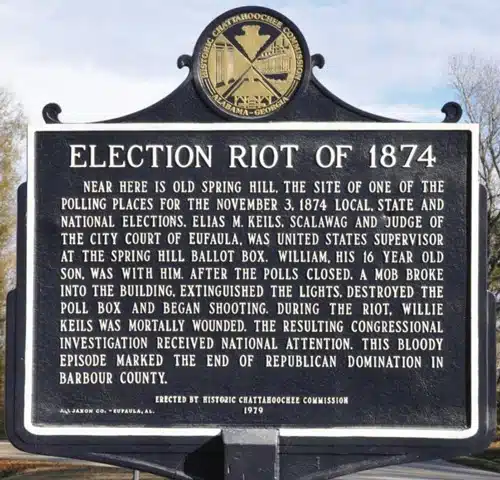
The way this history is remembered, or more accurately, forgotten, deserves particular attention. The historical marker erected in 1979 near Old Spring Hill reads:
Near here is Old Spring Hill, the site of one of the polling places for the November 3, 1874 local, state and national elections. Elias M. Keils, scalawag and Judge of the City Court of Eufaula, was United States supervisor at the Spring Hill ballot box. William, his 16 year-old son, was with him. After the polls closed, a mob broke into the building, extinguished the lights, destroyed the poll box and began shooting. During the riot, Willie Keils was mortally wounded. The resulting Congressional investigation received national attention. This bloody episode marked the end of the Republican domination in Barbour County.
This marker’s language, calling it a “riot” rather than a massacre and omitting the deaths and injuries of Black voters, reflects how this history has been sanitized. More troubling still, the 1874 election massacre isn’t included in Alabama’s state history curriculum, ensuring that generations of residents remain unaware of this pivotal moment in their county’s history. Today, a Confederate monument stands where the massacre occurred, and in a bitter irony, S.H. Dent, a possible massacre participant, spoke at that monument’s unveiling.
What an honest historical marker might say:
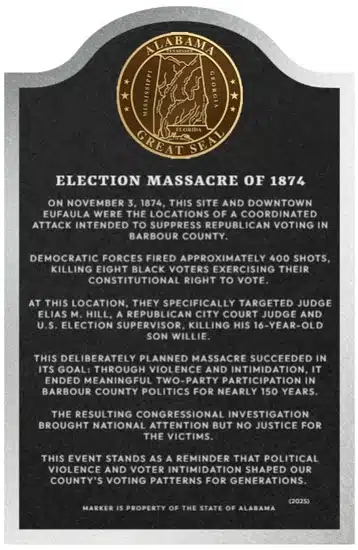
Election massacre of 1874
On November 3, 1874, this site and downtown Eufaula were the locations of a coordinated attack intended to suppress Republican voting in Barbour County.
Democrat forces fired approximately 400 shots, killing eight Black voters exercising their constitutional right to vote.
At this location, they specifically targeted Judge Elias M. Keils, a Republican city court judge and U.S. election supervisor, killing his 16-year-old son Willie.
This deliberately planned massacre succeeded in its goal: through violence and intimidation, it ended meaningful two-party participation in Barbour County politics for nearly 150 years.
The resulting Congressional investigation brought national attention but no justice for the victims.
This event stands as a reminder that political violence and voter intimidation shaped our county’s voting patterns for generations.
The hidden truth
This history demands examination not because it’s comfortable, but precisely because it isn’t. The most profound irony lies in how thoroughly this history has been buried.
Today, many Black residents of Barbour County identify as lifelong Democrats, not knowing their ancestors were Republican voters who were terrorized into either not voting at all or voting Democrat.
Consider Michael Farmer, a Black resident of Spring Hill and lifelong Democrat, who hopes “the young folks might think about what their ancestors came through to get where we are.” Yet the full truth of what those ancestors went through has been hidden: They were Republicans, murdered and intimidated by Democrats specifically to end Republican voting in Barbour County Alabama.
Generational impact
The sanitization of this history, from calling it a “riot” instead of a massacre, to omitting the political affiliations of the perpetrators and victims, has created a false narrative.
The violence of 1874 helped destroy meaningful Republican participation among Black voters in Barbour County and shaped the political environment inherited by later generations. Modern political identity has many causes, but we cannot understand Barbour County’s history without acknowledging that violence helped determine which political choices were considered safe or possible.
Vote Democrat or die: that’s not tradition, it’s trauma.
And like all trauma, it shapes behavior long after the reason is forgotten. Just as my great-grandchildren won’t carry my personal fears, but might inherit the patterns those fears created.
The trauma doesn’t disappear just because the memory does.
There’s more to what Barbour County remembers
Some local history survives in records. Some survives because people keep repeating it. I wrote more about how I separate the two, and why I’d rather leave better records behind now.
Barbour County has always had more stories than answers
Sources and further reading
- Equal Justice Initiative, “Eufaula, Alabama”
- Encyclopedia of Alabama, “Election Riots of 1874”
- Congressional reports on the Alabama election of 1874
- Historic Chattahoochee Commission marker record
- Melinda M. Hennessey, “Reconstruction Politics and the Military: The Eufaula Riot of 1874”