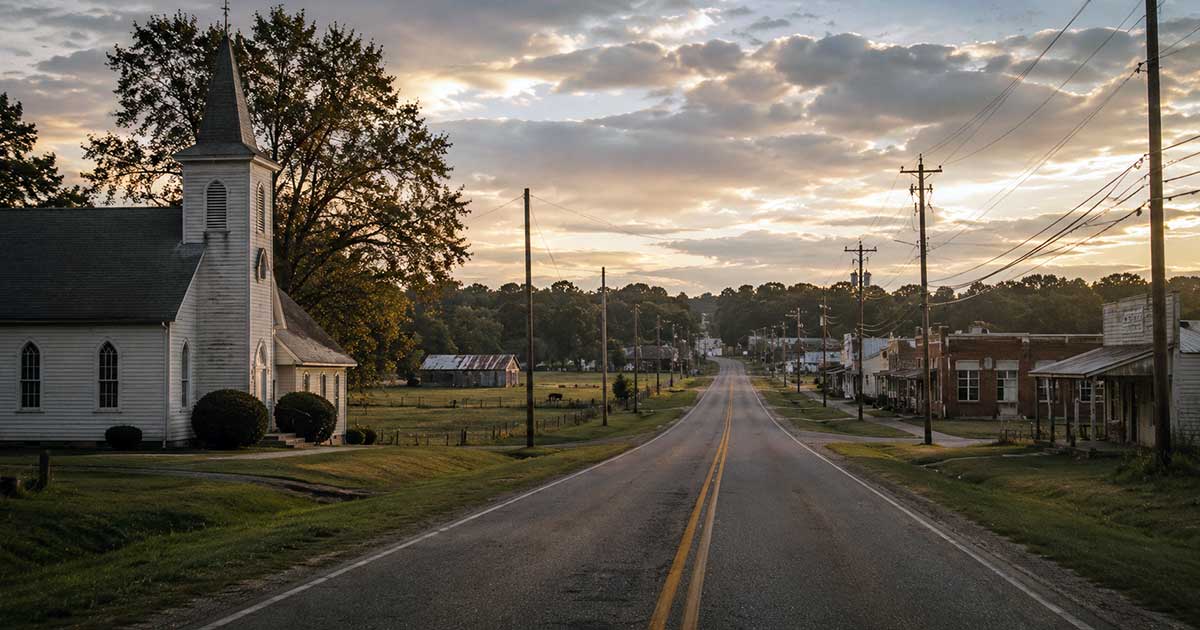
Most people who pass through Barbour County, Alabama, see a road.
They see U.S. 431 through Eufaula, maybe Highway 51 toward Clayton, maybe one of the smaller roads cutting across the county. They pass gas stations, churches, fields, timber, old houses, a few businesses, and signs for towns they may never actually enter.
Then they keep going.
If that’s all you see, Barbour County probably looks like one long stretch of rural Alabama. It isn’t. Drive around it long enough and the county almost changes personality depending on where you are.
Subscribe to Field Notes
The stories and ideas I don’t want you to miss.
For a lot of people outside the county, Eufaula is Barbour County. That makes sense. It’s the largest and most visible city here, with the lake, historic homes, commercial development, courthouse presence, and highway traffic. With a connection to Katie Couric and a late-1970s visit from the Jackson family to see relatives, a story that only resurfaced in recent years, Eufaula also has an outsized presence in how the county is seen from the outside.
Drive west and things start changing. The businesses thin out. Town centers get smaller. The distance between things gets longer. You see more farmland, timber, older churches, empty buildings, schools serving wide areas, and roads that mean a lot to the people who use them and almost nothing to everybody else.
Clayton doesn’t look or feel like Eufaula. Louisville doesn’t look or feel like Clayton. Clio, Bakerhill, Blue Springs, and the rural communities between them add their own versions of the county.
Some of those differences are obvious. Others aren’t.
Clayton still has old buildings that remind you there was a time when smaller towns carried more business, traffic, and daily activity than they do now. Some have been maintained or repurposed. Others have sat long enough to become part of the scenery. You can look at one of those buildings and see decline. You can also see evidence that something used to happen there.
Louisville is easy to pass through if you don’t have a reason to stop. That doesn’t mean nothing is there. It means the scale is smaller, and in a place this small, what’s important to the people who live there isn’t always obvious from the road.
That includes its history. Louisville became the seat of Pike County in 1821 and later became the first county seat of Barbour County before the seat moved to Clayton in 1834.
But history isn’t the only thing that changes with scale.
A church, fire station, little store, ball field, city hall, or road that looks ordinary to somebody passing through can be tied to half the town’s memories. Government feels different too. In a town Louisville’s size, the distance between the person making a decision and the person affected by it can be a few feet instead of several departments. Everybody knows who made the decision, who didn’t fix the problem, and who said what at the meeting.
Clio carries a different history again. George Wallace and Don Sutton were both born there, two people who became known far beyond a town most travelers could pass through without giving much thought. Clio also had traditions like the Chitlin’ Jamboree, the kind of local event that gave a place an identity that never showed up on a highway sign.
A county can look pretty compact until you start driving it.
Barbour County covers about 885 square miles, making it the 16th-largest county in Alabama by area. That’s roughly six times the land area of Birmingham and about 85 percent of the land area of Rhode Island. That’s a lot of ground for one county to cover, and that size is part of why communities that share the same county line can still feel pretty far removed from one another.
That distance also changes more than travel time. It affects what businesses can survive, which roads people depend on, where people gather, and whether something that looks close on a map feels close when you actually have to get there.
Then there are places where the town itself isn’t really the center of daily life. There are empty places all over Barbour County. Old stores, houses, gas stations, and commercial buildings sit beside roads where people eventually stop noticing them.
Sometimes they are exactly what they look like: evidence that something was lost. I don’t think we need to turn that into nostalgia or pretend every old building represents some better version of the county. But those buildings aren’t the whole story either. People are still working, raising families, running businesses, farming, teaching, volunteering, going to church, coaching kids, fixing things, and trying to make something work where they are.
Most of that isn’t visible through a windshield at 55 miles an hour. Neither are the smaller places. You can live in Barbour County for years and still find roads you’ve never driven. Turn off a highway and you may pass a church you’ve heard about forever, an old cemetery, a farm, a community you knew by name but had never actually seen, or a building that makes you wonder what used to be there.
That’s the Barbour County I think gets flattened when we talk about “rural Alabama” or “small-town Alabama” as if either one describes a single kind of place. It doesn’t even describe one kind of place inside this county.
One community may be trying to attract growth while another is trying to keep what it still has. One place may depend more on agriculture while another depends more on government, retail, schools, industry, or people commuting somewhere else. One town may have buildings being restored while another has buildings nobody can afford to save.
So when we talk about economic development, roads, schools, healthcare, public safety, or government at the county level, the county line can hide as much as it explains. A solution that makes sense in Louisville may not solve the same problem in Eufaula. Something that works in one rural community may not fit another ten miles away. They share a county. They don’t share the same circumstances.
I don’t think Barbour County needs to be sold as something it isn’t. We have beautiful places and empty buildings. We have history worth preserving and history we’d probably rather not talk about. We have towns that still feel active and places where you can see what has been lost. We have people trying to build things and people wondering whether their children will have a reason to stay.
That’s a lot more interesting to me than pretending the whole county can be understood from the highway. Most people will keep driving through and see rural southeast Alabama somewhere between where they started and where they’re going. They’re seeing Barbour County.
They’re just not seeing very much of it.